


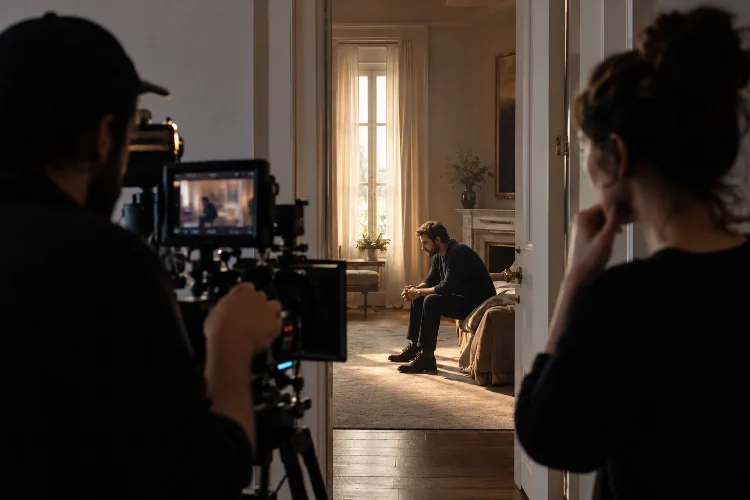
A movie never shows us everything. It chooses where to begin, whose perspective to follow, what information to hide, and which moments deserve our attention.
Those choices form what we can broadly call narrative framing in contemporary cinema, and they can completely change the meaning of a story.
The same event can appear romantic from one character’s perspective, threatening from another, or tragic once new information is revealed.
Filmmakers increasingly use framing devices, fragmented memories, unreliable narrators, shifting perspectives, and genre changes to influence how audiences interpret what they see.
This is why modern films such as Gone Girl, Parasite, Aftersun, and The Last Duel often reward close attention. Their meaning does not exist only in plot events. It also emerges from how those events are presented.
Understanding narrative framing therefore helps us see cinema differently. Instead of asking only, “What happened?”, we begin asking a more interesting question: “Why did the filmmaker choose to show it to us this way?”
What Is Narrative Framing in Film?
Narrative framing is the process through which a story controls the audience’s access to information.
That can involve point of view, chronology, voice-over, flashbacks, camera perspective, character knowledge, genre expectations, or even the decision to place one scene before another.
A filmmaker does not simply deliver information; they organize it into a particular interpretive frame.
This distinction is important because events do not carry fixed meaning on their own.
Imagine a scene in which a character secretly enters another person’s house. Framed as a comedy, the act may feel ridiculous.
Presented through horror conventions, the exact same action could feel terrifying. If the audience later discovers that the intruder owns the house, the meaning changes again.
Cinema constantly performs this kind of reframing.
Film theory also distinguishes between what happens in a fictional world and how the audience is allowed to experience it. Camera distance, visual framing, and narrative perspective can guide attention, establish emotional hierarchies, and influence how spectators relate to characters.
Cambridge scholar Per Persson, for example, argues that cinematic framing helps direct audience attention and can significantly affect emotional response.
Point of View Determines Whose Reality Matters
One of the strongest framing tools in cinema is perspective.
Audiences usually understand fictional events through the character whose experience receives the most screen time, emotional access, or visual emphasis. This means point of view can quietly determine which version of reality appears reasonable.
Ridley Scott’s The Last Duel makes this process unusually visible.
The film revisits key events from three perspectives: Jean de Carrouges, Jacques Le Gris, and Marguerite de Carrouges. Although many events appear similar, details shift depending on who is remembering or interpreting them.
Sight and Sound noted that the film treats the chapters almost like separate films, with differences in characterization, tone, and even genre emphasis.
What seems heroic in one version may appear selfish in another.
The technique reveals something audiences experience in less obvious ways across countless films: perspective is never neutral.
Who controls the narrative often controls the initial meaning.
Unreliable Narration Makes Audiences Question What They See
Narrative framing becomes especially powerful when audiences discover that their guide cannot be trusted.
An unreliable narrator may lie intentionally, misunderstand events, suffer from incomplete memory, or simply interpret reality through personal bias. Once the audience recognizes this unreliability, earlier scenes often take on new meanings.
David Fincher’s Gone Girl is an effective example.
The film initially encourages viewers to construct assumptions about Nick and Amy Dunne through carefully selected information. Diary entries, media coverage, performances of grief, and competing versions of their marriage continually reshape what appears believable.
Sight and Sound’s discussion of the film highlights how its storytelling keeps multiple uncertainties surrounding the characters in play, making instability itself part of the narrative pleasure.
This kind of framing encourages skepticism.
Instead of accepting every scene as objective truth, viewers begin asking who is presenting the information and what that person gains from presenting it that way.
That habit is increasingly central to contemporary screen storytelling.
Reframing the Same Event Can Change Moral Judgment
Narrative framing does not simply influence what viewers know. It affects whom they sympathize with.
A character presented first as a victim may later appear manipulative. Someone introduced as selfish may become sympathetic once previously hidden circumstances are revealed.
The Last Duel demonstrates this directly.
Its male perspectives initially position Marguerite largely in relation to the ambitions and assumptions of men.
Her own chapter then changes the emotional and moral framework surrounding earlier events. Contemporary reviews noted that this final viewpoint overturns elements of the male-centered versions that came before it.
The events are not simply repeated.
Their significance changes.
This is one of narrative framing’s most powerful features. It reminds viewers that judgment depends heavily on context, sequencing, and access to information.
In practical screenwriting terms, this means revealing information later can be just as important as deciding what information to reveal.
Genre Can Function as a Narrative Frame
Framing does not always come from a narrator or character perspective. Genre itself can influence interpretation.
Audiences enter films carrying expectations.
A romantic comedy teaches us to interpret awkward encounters as possible beginnings of relationships. A thriller makes us suspicious. Horror encourages us to search ordinary spaces for danger.
Contemporary filmmakers often exploit these expectations by changing genres during the story.
Bong Joon Ho’s Parasite is a particularly strong example. The film moves through social realism, black comedy, domestic infiltration, thriller, horror, and tragedy without completely abandoning any of them.
BFI describes the film as strikingly “chameleonic” in its genres, using those transformations to deepen its examination of inequality.
That genre movement changes how we perceive the Kim family.
Their schemes can initially feel comic and clever. Later, the same behavior sits within a much darker structure involving desperation, exploitation, and class resentment.
The plot has not suddenly become unrelated to what came before.
The frame has shifted.
Visual Framing Can Change Narrative Meaning Without Dialogue
Narrative framing is not limited to screenplay structure.
Cinema is visual, which means composition itself can shape interpretation.
Where characters appear within the frame, whether the camera gives them space, what remains hidden, and how locations are organized can all affect meaning.
Parasite demonstrates this visually through architecture.
The wealthy Park family occupies a sleek home filled with open space, sunlight, and elevated surfaces.
The Kim family lives in a semi-basement apartment closer to street level. Sight and Sound notes that the film’s production design and repeated use of staircases reinforce its class divisions.
The audience therefore does not need constant dialogue explaining economic inequality.
The framing already communicates it.
Characters repeatedly move upward and downward through physical spaces, transforming architecture into a visual metaphor for social mobility.
This shows why cinematic framing can be more effective than exposition. Audiences often understand an idea emotionally before anyone explains it verbally.
Memory Creates a Different Kind of Narrative Frame
Some contemporary films are framed not by objective chronology but by memory.
Memory is selective, incomplete, and often reshaped by later experience. When filmmakers build stories around recollection, those qualities can influence every scene.
Charlotte Wells’ Aftersun offers a powerful example.
The film centers on Sophie remembering a childhood holiday with her father Calum. Yet those memories are implicitly being reconstructed by an older Sophie who understands things that her younger self could not.
Sight and Sound describes the film as presenting childhood memories through the adult character’s attempt to piece together her father’s hidden pain.
This creates a double perspective.
Young Sophie experiences a holiday.
Older Sophie remembers signs of emotional struggle.
The audience effectively occupies both positions at once.
Scenes that might look ordinary from a child’s perspective therefore become deeply sad when understood through the future.
The framing turns memory into interpretation rather than simple recollection.
That slight ambiguity is also what gives the film much of its emotinal power.
Withholding Information Creates Meaning Through Absence
Filmmakers often shape interpretation by refusing to explain everything.
This can initially seem like incomplete storytelling, but ambiguity is frequently deliberate.
When audiences lack certain information, they naturally begin filling gaps with assumptions.
That process turns absence into meaning.
Aftersun again provides a useful example. Charlotte Wells deliberately avoids explaining every detail about Calum’s life or emotional state.
In an interview discussing the film, Wells described carefully calibrating narrative elements and considering how much information audiences needed for the film to remain legible.
The lack of definitive answers makes viewers pay greater attention to gestures, silences, images, and repeated motifs.
This approach is very diferent from exposition-heavy filmmaking.
Rather than telling audiences exactly what something means, the film provides enough material for interpretation while preserving uncertainty.
When handled well, this ambiguity can make viewers emotionally participate in constructing meaning.
Narrative Framing Also Shapes Social and Political Interpretation
Framing becomes particularly important when films address issues such as class, gender, race, power, or historical memory.
The person positioned at the narrative center usually receives greater complexity.
Background characters often become simplified precisely because the audience rarely sees the world from their perspective.
Contemporary cinema increasingly plays with this imbalance.
Parasite, for example, initially positions the economically struggling Kim family as inventive protagonists. Their deception is entertaining partly because audiences experience their economic desperation closely.
But the introduction of another struggling household complicates that frame.
Suddenly the conflict is not simply poor versus rich.
It becomes poor versus poor within a system in which access to resources is extremely unequal.
That reframing makes the social critique more complex.
BFI commentary on the film emphasizes how its carefully designed spaces and shifting tone expose the brutality of class division rather than presenting inequality as a simple conflict between good and bad individuals.
Narrative perspective therefore has ideological consequences.
Who gets to speak – and who remains outside the frame – matters.
Why Reframing Makes Films More Rewatchable
Some of the most memorable contemporary films become different experiences on a second viewing.
That happens because later information has altered the viewer’s interpretive frame.
After learning a secret, understanding a character’s motivation, or recognizing an unreliable perspective, audiences return to earlier scenes with new knowledge.
Nothing onscreen has changed.
The viewer has.
This is why films built around careful framing often reward rewatching. Small gestures suddenly seem significant. Dialogue gains double meanings. Visual details that once appeared decorative become clues.
The effect shows how meaning in cinema is rarely fixed.
It emerges through the relationship between information, perspective, sequence, and audience knowledge.
A filmmaker can therefore change the meaning of an entire scene without changing that scene itself. All that is required is a later piece of information that teaches audiences how to reinterpret what they already saw.
That is an incredibly poweful storytelling tool.
Narrative framing shapes almost every aspect of how audiences understand contemporary cinema.
Point of view determines whose experience feels authoritative, unreliable narration creates doubt, genre shifts alter expectations, and visual composition can communicate ideas without a single line of dialogue.
Films such as Gone Girl, Parasite, Aftersun, and The Last Duel demonstrate that meaning comes not only from events themselves, but from the way those events are presented.
For filmmakers, writers, and serious movie fans, studying narrative framing offers a useful new way to watch cinema. The next time a film changes your opinion of a character or makes an earlier scene suddenly feel completely different, ask what changed.
Often, the answer is not the story itself. It is the frame around it.
