


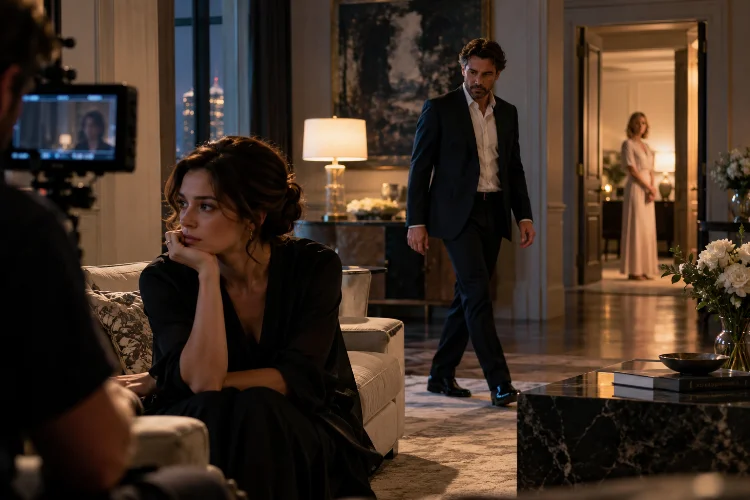
A great film scene can guide your eyes without you ever noticing.
You may naturally look at the character standing near a doorway, shift attention when someone crosses the room, or suddenly notice a silent figure in the background.
None of this has to be explained through dialogue. Often, the director is controlling your attention through blocking.
In filmmaking, blocking refers to how actors are positioned and moved through a scene in relation to the camera, set, props, and other performers.
It is one of the most powerful tools for visual storytelling because it helps determine what viewers notice first, how they interpret relationships, and where emotional tension develops.
Understanding how directors use blocking to control visual attention within film scenes also reveals why some sequences feel dynamic even when very little “action” is happening.
Strong blocking transforms space into storytelling. Distance can suggest emotional separation, movement can reveal changing power, and a character stepping into the foreground can instantly reshape the audience’s focus.
What Does Blocking Mean in Film?
Blocking is essentially the choreography of actors within cinematic space.
It determines where performers stand, when they move, how they interact with objects, and how those choices work with camera placement.
MasterClass describes blocking as a process involving actors’ movement, body position, sight lines, and camera relationships. Importantly, those decisions influence where the audience looks and how viewers emotionally engage with a scene.
That last point is crucial.
Blocking is not simply logistical.
A director does not move an actor across a room just because the frame looks empty. Ideally, movement reflects something about the character’s intention or changes how we understand the scene.
StudioBinder similarly notes that performance blocking includes both movement through space and interaction with the environment. When combined with camera placement and movement, it can create strong psychological effects for viewers.
In other words, blocking is part acting direction, part composition, and part visual psychology.
Positioning Determines What the Audience Notices First
Where a character stands inside the frame immediately affects visual hierarchy.
A performer placed in the foreground often attracts more attention than someone deep in the background. A character standing alone can become visually dominant even if several other people occupy the frame.
Directors exploit this constantly.
Imagine five people gathered around a dinner table. Four sit closely together while one person remains several feet away near a window.
Before anyone speaks, the blocking already communicates isolation.
The audience naturally begins wondering why that character is separate from the group.
Composition techniques reinforce this effect. StudioBinder notes that blocking can work with leading lines and other compositional devices to guide the viewer’s eye toward important visual information.
This makes actor placement a storytelling decision.
A director can tell us who matters in the moment simply by controlling where everyone occupies the image.
Movement Can Redirect Attention Without Cutting
Editing is one obvious way to control viewer attention.
A director can simply cut from one character to another.
Blocking provides another option.
If a stationary scene suddenly includes movement, the moving object usually attracts the eye. A character who stands up, crosses the room, or approaches another performer can become the new visual focus without requiring a cut.
This is especially useful in long takes.
Directors such as Steven Spielberg often stage scenes so that movement continually reorganizes the frame. Instead of cutting every time the dramatic focus changes, actors and camera reposition themselves.
StudioBinder’s analysis of staging discusses how directors including Spielberg, Stanley Kubrick, and Alejandro González Iñárritu combine actor movement with camera movement to continuously reshape a scene.
The result can feel very natural.
The audience does not consciously think, “Now I am supposed to watch this person.”
They simply follow the movement.
That invisible control is one of the clearest signs of effective blocking.
Depth Creates Multiple Levels of Visual Meaning
Film scenes do not have to operate only from left to right.
Directors can use foreground, middle ground, and background to create visual depth.
This allows several pieces of information to exist inside the same shot.
A conversation might occur in the foreground while another character silently reacts in the background. That background reaction may completely change how we interpret the dialogue.
This technique gives audiences choices while still guiding attention.
The director may begin with two characters close to the camera, then move one aside and reveal someone previously hidden deeper in the frame.
The blocking creates the reveal.
It also makes scenes visually richer because the frame contains layers rather than a flat arrangement of actors.
Depth can also communicate power.
A character moving closer to camera may begin to feel more dominant, while someone pushed deeper into the composition can appear smaller or less important.
Strong directors treat the frame almost like architecture.
Every distance means something.
Blocking Can Reveal Power Without Dialogue
One of the most useful functions of blocking is showing who controls a scene.
Power can be visualized through height, distance, position, and movement.
A dominant character might stand while everyone else sits.
Another may occupy the center of a group while others form a semicircle around them.
A subordinate figure might remain near the edge of the frame.
These choices can communicate hierarchy before a word is spoken.
Blocking becomes especially interesting when power changes during the scene.
Perhaps one character begins seated while another walks around them confidently. Later, the seated character stands, forcing the other to retreat.
That physical shift becomes a visual representation of changing control.
StudioBinder notes that blocking choices can visualize power dynamics and dramatic relationships rather than simply organize performers inside the shot.
This is why directors often think carefully about who moves first.
Movement can suggest confidence.
Stillness can suggest authority.
Retreat can suggest vulnerability.
Sometimes the scene’s deepest argument is happening through bodies rather than dialogue.
Eyelines Guide the Viewer Toward Important Information
Where characters look is another form of blocking.
Human viewers naturally follow other people’s gaze.
If three characters suddenly look toward the same doorway, audiences will immediately want to know what is there.
Directors can use eyelines to prepare reveals, build suspense, or move attention from one side of the frame to another.
This is particularly useful in ensemble scenes.
Instead of cutting immediately to the important character, the filmmaker can first show several people reacting.
Their gaze effectively points through the image.
Eyelines also establish relationships.
Two characters facing each other directly can feel confrontational or intimate.
A person who refuses eye contact may appear uncomfortable, dishonest, or emotionally distant.
When paired with physical distance, these small blocking choices can communicate enormous amounts of subtext.
The audience may not consciously analyze where everyone is looking.
But emotionally, they understand it.
Negative Space Can Make a Character Impossible to Ignore
Directors do not always attract attention by filling the screen.
Sometimes they do it through emptiness.
Negative space refers to visually empty areas surrounding a subject.
A character standing alone inside a large room can appear more isolated because the empty environment dominates the composition.
Blocking determines how that emptiness is used.
Move the character to one edge of the frame and suddenly the empty space beside them may feel threatening.
Place another character inside that space later, and the visual relationship changes instantly.
Negative space can also create anticipation.
If a character repeatedly looks toward a large empty area of the frame, audiences may expect something to enter it.
That expectation creates tension.
Directors can therefore use emptiness almost like another performer.
What is not occupying the frame can become as important as what is.
Actor Movement Should Usually Have Motivation
Random movement rarely creates effective blocking.
If characters constantly walk around without emotional or practical reasons, the scene can feel artificial.
Strong blocking usually grows from motivation.
A character approaches someone because they want intimacy.
They step backward because they feel threatened.
They cross the room because they are avoiding a difficult conversation.
MasterClass emphasizes that blocking should emerge from what characters think, feel, want, or need, with rehearsals allowing actors and directors to discover movements that fit those intentions.
This is why “business” can also help.
A character might cook, clean, organize papers, or pour a drink while speaking. Those actions make the scene feel less staged while also giving the director opportunities to reshape visual focus.
Movement becomes believable because it has a practical purpose.
The best blocking often looks effortless precisely because the audience never notices the design behind it.
Camera Movement and Blocking Work Together
Blocking cannot be separated completely from cinematography.
An actor’s movement changes meaning depending on where the camera is positioned.
Walking toward another character may feel aggressive in a wide shot but intimate in a close shot.
The camera can also move in response to performers.
A dolly shot might follow one character before transferring attention to another. A pan can reveal a previously unseen figure. A handheld camera can react unpredictably to movement, creating tension.
No Film School describes blocking as a coordination between actor choreography and camera placement, emphasizing that both need to communicate clearly with the audience.
This collaboration often begins before shooting.
Directors, cinematographers, and actors rehearse scenes to determine where movement will happen and how the camera should respond.
The final composition is therefore rarely accidental.
Even seemingly spontanous movement may be carefully planned.
12 Angry Men Shows How Blocking Keeps a Static Location Dynamic
Sidney Lumet’s 12 Angry Men remains one of the clearest examples of blocking as visual storytelling.
Most of the film takes place inside a jury room.
That could easily become visually repetitive.
Instead, Lumet constantly changes character positions, groupings, movements, and camera relationships.
No Film School has highlighted the film as a masterclass in blocking because Lumet integrates actor staging and camera movement to keep the confined setting visually active.
As opinions within the jury change, physical relationships change too.
Characters who initially dominate the room can gradually become isolated.
Groups form and dissolve.
People move away from characters whose arguments they no longer support.
The physical space becomes a map of the debate.
This demonstrates an important principle: blocking does not require huge sets or spectacular action.
Even one room can become visually dynamic when character movement continually reflects changing relationships.
Good Blocking Creates Subtext
Dialogue communicates what characters say.
Blocking can communicate what they actually feel.
Imagine a couple saying that everything is fine while standing on opposite sides of a large room.
The words suggest harmony.
The bodies suggest separation.
That contradiction creates subtext.
Directors can use proximity, orientation, and movement to communicate emotions characters refuse to express openly.
A person might say they are not jealous while slowly moving between their partner and another character.
Someone may claim they feel relaxed while repeatedly moving toward the exit.
These physical decisions add another layer to performance.
StudioBinder describes blocking as part of mise-en-scène that can reveal what is happening both on the surface and underneath the scene.
That is why careful blocking can make simple dialogue feel much deeper.
The audience reads the body even when the script says something else.
Directors use blocking to control visual attention by organizing where actors stand, when they move, what they look at, and how they relate to the camera and environment.
Foreground placement can create dominance, depth can reveal hidden information, eyelines guide attention, negative space creates tension, and movement can shift focus without a single edit.
The most effective blocking also grows from character motivation. It does not simply make a frame look attractive; it turns physical space into dramatic meaning.
For filmmakers, the practical lesson is simple: before adding more dialogue or another close-up, study where the actors are standing.
For viewers, try watching your favorite scene with the sound muted. You may be surprised by how much of the story remains visible through movement, distance, and composition alone.
