


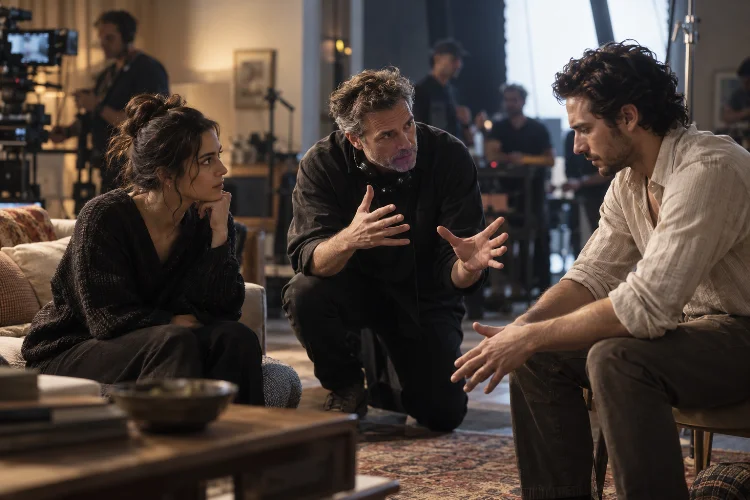
“Be sadder.” “Make it angrier.” “Can you give me more emotion?”
Those directions sound simple, but they often create weak performances.
Actors usually cannot produce believable emotion just because a director names the desired result. Strong performances come from something more specific: intention, behavior, relationships, physical action, subtext, timing, and trust.
That is why directing performance requires more than traditional acting notes.
The director’s job is not merely to tell an actor how a scene should look from the outside. It is to help create conditions where the performance feels alive from the inside.
Acting teacher and director Judith Weston has long argued against result-oriented direction, recommending playable tools such as verbs, facts, imagery, physical life, and emotional events instead.
This difference can completely change a scene.
Instead of saying, “Be more desperate,” a director might say, “Convince her not to leave.” The first gives the actor an emotion to imitate. The second gives them something to do.
That is where useful performance direction begins.
Traditional Acting Notes Often Describe Results, Not Process
Many weak acting notes describe what the director wants to see.
“Look nervous.”
“Cry here.”
“Sound more confident.”
The problem is that these instructions focus on the final appearance rather than the inner action producing it.
Weston calls this result-oriented direction. She argues that directing actors works better when directors think in terms of playable actions and subtext rather than micromanaging expressions or line readings.
Consider the difference between two notes.
“Be more aggressive” is vague.
“Make him admit he lied” gives the actor a target.
The second note creates behavior because the performer now has something to pursue.
That pursuit may naturally become aggressive, calm, manipulative, charming, or threatening depending on the actor’s interpretation.
This gives the performance life.
Good directors therefore focus less on controlling the visible result and more on activating the process underneath it.
Objectives Give Actors Something Playable
One of the most practical tools in performance direction is the objective.
An objective answers a simple question: what does the character want from the other person right now?
That might be reassurance.
Permission.
Forgiveness.
Control.
Respect.
The objective turns dialogue into action.
Imagine a breakup scene.
A director could say, “You are heartbroken.”
But that does not necessarily help the actor play the moment.
A stronger note might be, “Make her stay.”
Now the performer can use the dialogue as a strategy.
One line may become persuasion.
Another becomes guilt.
Another becomes humor.
Another becomes attack.
This creates variation inside the scene.
Weston’s approach emphasizes verbs, intentions, and emotional events precisely because they give actors something concrete to play rather than something abstract to demonstrate.
That is usually far more useful than asking for a generic emotion.
Subtext Matters More Than the Literal Dialogue
Actors do not only perform words.
They perform what exists underneath the words.
A character may say, “I’m happy for you,” while actually thinking, “I hate that you got what I wanted.”
That hidden layer is subtext.
Good performance direction helps actors understand the emotional logic beneath the dialogue.
Weston argues that strong scenes depend on subtext becoming more alive than the spoken text itself.
This is particularly important in subtle drama.
Characters rarely say exactly what they mean.
People avoid embarrassment, protect pride, hide attraction, or disguise anger.
A director who focuses only on line delivery may miss the real scene.
Instead, the useful question becomes: what is actually happening between these people?
Once actors understand that, tone often emerges naturally.
The director does not need to force “more tension.”
The situation creates it.
Blocking Can Influence Performance From the Outside In
Performance direction also includes physical behavior.
Where an actor stands, when they move, and how close they are to another character can affect emotional dynamics.
This is blocking.
A character who remains seated while another circles the room may feel vulnerable.
Two people forced into close physical proximity may create tension without changing a word of dialogue.
Movement can therefore generate emotion indirectly.
This is useful because actors sometimes discover performance through physical action.
A director might ask one character to fold clothes during an argument instead of simply standing still.
Suddenly the actor has something to do.
The mundane task can create avoidance, irritation, or emotional repression.
Directors who combine blocking with performance often find that behavior becomes more believable because emotion is attached to action.
The body gives the scene another layer of meaning.
Different Actors Need Different Kinds of Direction
There is no single perfect directing language.
Some actors love discussing backstory.
Others prefer short action verbs.
Some respond to imagery.
Others want practical objectives.
Some need space.
Others want detailed conversation.
That is why directing performance requires observation.
Richard Eyre, widely regarded as an actor-friendly director, has been praised by performers for creating an enabling working environment rather than forcing one method on everyone.
The director has to learn what helps each performer.
This can happen during rehearsal, script discussion, or even early takes.
If a detailed psychological explanation makes one actor more self-conscious, simplify.
If another actor needs deeper context before performing, give it.
Directors who insist that every performer respond to the same note often create unnecessary friction.
The goal is not consistency of method.
It is consistency of result.
Listening Is Part of Directing
Directing actors is often imagined as giving instructions.
In reality, listening may be equally important.
Actors bring ideas, instincts, and discoveries that were not visible on the page.
A director who shuts those down immediately may lose something valuable.
Weston recommends listening more than talking and remaining flexible enough to build on what performers naturally bring.
This does not mean the director gives up authority.
The director still needs a clear vision.
But strong direction can involve shaping rather than controlling.
If an actor makes an unexpected choice that still serves the scene, the director may decide to develop it instead of replacing it.
That creates collaboration.
And collaboration often produces performances that feel less mechanical and more human.
Rehearsal Is About Discovery, Not Just Repetition
Rehearsal is sometimes treated as a way to lock everything down.
That can be useful for technical scenes, but performance rehearsal often works best as a place to explore.
Directors can test objectives.
Actors can try different tactics.
Blocking can evolve.
Unexpected rhythms can appear.
Television director Fred Toye has described entering rehearsals with ideas but being willing to throw them away temporarily so actors can discover the scene for themselves.
He also warns against overdirection and emphasizes giving performers time to find the moment.
This attitude creates flexibility.
A rehearsal should answer questions, not simply confirm decisions made in advance.
What happens if the scene is played quietly instead of aggressively?
What if a character avoids eye contact?
What if the emotional break happens later?
Exploration can reveal choices that no one anticipated.
That discovery is often where the performance becomes interesting.
Trust Changes the Quality of Performance
Actors are unusually exposed when performing.
They are asked to show vulnerability, embarrassment, anger, desire, grief, and fear while surrounded by cameras, crew, lights, and time pressure.
That makes trust essential.
Director Margarethe von Trotta has spoken about the importance of creating a safe environment around actors because of that vulnerability.
Trust allows actors to take risks.
Without it, performers may protect themselves.
They become more cautious.
Their choices shrink.
A director builds trust by being prepared, listening, avoiding humiliation, and giving notes privately when necessary.
Even small behavior matters.
Actors want to know the director is paying attention.
They want feedback that is specific rather than vague.
A safe set does not mean avoiding difficult material.
It means creating conditions where difficult material can be explored honestly.
Rhythm Can Change a Performance Without Changing Emotion
Sometimes a scene does not need “more emotion.”
It needs different rhythm.
A pause may be too short.
An interruption may come too late.
A line might need to land before the other character has time to think.
These timing adjustments can transform performance.
Directors can shape rhythm by changing pace, overlapping dialogue, holding silence, or delaying reactions.
This is especially useful when actors already understand the emotional content but the scene still feels flat.
Instead of saying, “Make it more intense,” a director might ask the actors not to leave gaps between lines.
Suddenly the scene becomes confrontational.
Or the opposite might work.
Adding silence can create discomfort.
Rhythm is playable because actors can actually do something with it.
“More intense” is abstract.
“Do not let him finish his sentence” is concrete.
That is a small distinction with a big effect.
Camera Placement Also Affects Performance
Film acting does not exist separately from cinematography.
The size of the shot changes what kind of performance works.
A gesture that feels natural in a wide shot may feel enormous in close-up.
Director Richard Eyre has pointed out that cinema gives filmmakers control through lenses, shot size, and editing in ways theater does not.
Directors therefore need to understand how performance will live inside the frame.
An actor may not need to “do more” if the camera moves closer.
A tiny shift in the eyes may become emotionally huge.
This is why strong directors coordinate acting notes with visual design.
Performance is not happening in isolation.
It is being photographed.
Knowing that can prevent overacting and unnecessary direction.
Emotional Truth Is More Important Than Emotional Display
One of the biggest mistakes in directing performance is assuming visible emotion equals strong acting.
It does not.
A character may feel devastated without crying.
Someone may be terrified while remaining physically still.
Another person may hide anger behind politeness.
What matters is whether the behavior feels emotionally truthful.
Weston identifies recognizing emotional truth as one of the key skills directors need when working with actors.
This requires judgment.
The director has to watch not only what the actor is doing, but whether the behavior belongs to the character and situation.
Sometimes the strongest note is to remove something.
Less gesture.
Less emphasis.
Less explanation.
A performance can become more powerfull when the actor stops trying to “show” the emotion.
The audience then has room to discover it.
Directing performance requires far more than traditional acting notes because actors do not create believable work simply by imitating emotions on command.
Strong direction comes from objectives, subtext, physical behavior, rhythm, blocking, trust, listening, and an understanding of how each performer works.
The director’s job is not to manufacture emotion from the outside.
It is to create playable conditions that allow emotion to emerge naturally.
That often means replacing “be sadder” with something specific like “stop him from leaving,” or replacing “make it intense” with a change in rhythm, distance, or behavior.
For filmmakers, the practical lesson is simple: stop directing the result. Direct the action, relationship, and circumstance underneath it. That is where convincing performance usually begins.
