


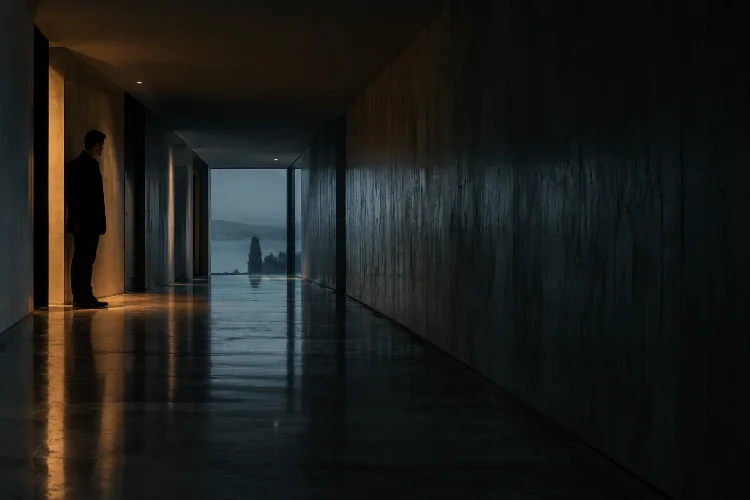
Sometimes the scariest part of a film frame is the part where nothing is happening.
A character may stand on the left side of the screen while a large, empty hallway stretches behind them. Nobody is visible. Nothing moves. Yet the audience starts watching that empty space more carefully than the character.
That reaction is exactly why negative space creates psychological film tension so effectively. In cinematography, negative space refers to the visually empty or unoccupied areas surrounding the main subject.
Directors can use that emptiness to isolate characters, suggest unseen danger, create visual imbalance, and make audiences anticipate something that has not happened yet.
The technique is especially powerful in horror and psychological thrillers because viewers instinctively search the frame for threats. Films such as The Invisible Man use seemingly empty areas to turn absence itself into a source of suspense.
Negative space therefore proves an important filmmaking principle: tension does not always come from showing more. Sometimes the audience becomes most uncomfortable when directors deliberately leave part of the image unresolved.
What Is Negative Space in Film?
Negative space is the area of a composition that is not occupied by the main subject. If a character stands alone in a large room, most of that room can become negative space.
If someone appears at the edge of a wide shot while an empty corridor dominates the opposite side, that corridor becomes visually important even though it contains nothing obvious.
StudioBinder defines negative space as the empty area around a subject and explains that filmmakers can use it to direct attention, communicate scale, and create emotional effects such as loneliness or isolation.
The important word is “empty.”
In cinema, empty does not necessarily mean meaningless.
The audience notices composition instinctively. When a director deliberately leaves a huge amount of frame space unused, viewers may begin wondering why.
That question creates attention.
And attention can quickly become tension.
Empty Space Encourages the Audience to Expect Something
Humans are pattern-seeking viewers.
When a movie frames a large empty area beside a character, we naturally expect that space to serve some purpose.
Horror filmmakers understand this extremely well.
StudioBinder notes that horror movies frequently use negative space because audiences learn to expect that something may eventually enter the empty portion of the frame.
Imagine a woman washing her face in a bathroom.
If she stands in the center of a tight close-up, the audience focuses primarily on her.
Now place her on the far right side while a dark doorway occupies most of the left side.
Suddenly we are watching the doorway.
The director has not shown a threat.
Instead, the composition has created the possibility of one.
That possibility can be more stressful than seeing the danger immediately.
The Invisible Man Turns Empty Frames Into Threats
Leigh Whannell’s The Invisible Man provides one of the clearest modern examples of negative space being used psychologically.
Because the central threat is invisible, the film repeatedly frames apparently empty rooms, corridors, kitchens, and doorways.
Nothing seems to be there.
But the audience knows that nothing visible does not necessarily mean nothing present.
No Film School highlights how the film uses excessive negative space to make viewers subconsciously search apparently empty parts of the image for a threat.
This creates a fascinating reversal.
Normally, audiences look at the subject.
In The Invisible Man, we frequently look away from the character and toward empty space.
The framing teaches us to distrust absence.
A chair, hallway, or patch of darkness becomes potentially dangerous because the threat does not need to occupy visible positive space.
The director therefore turns emptiness into narrative information.
That is a remarkably eficient way to build suspense.
Negative Space Can Make Characters Look Vulnerable
Psychological tension does not always require a hidden monster.
Sometimes negative space makes a character feel small.
Wide shots can place a person against a huge landscape, building, corridor, or room. The imbalance between the character and environment creates vulnerability.
No Film School notes that filmmakers often use wide shots with negative space to emphasize isolation, emotional distance, and a character’s apparent smallness within a larger environment.
This works because scale affects psychological interpretation.
A character filling most of the frame may appear powerful or visually secure.
The same character reduced to a tiny figure inside an enormous composition can appear exposed.
Films such as Her and Lost in Translation frequently use large urban environments around solitary characters, visually emphasizing their emotional isolation.
In thrillers, that same technique can create danger.
The character seems surrounded by space they cannot fully control.
And anything could exist inside it.
Off-Center Framing Creates Visual Imbalance
Traditional compositions often create a sense of visual balance.
Directors can deliberately break that balance.
Place a character unusually close to one edge of the frame and the remaining empty space starts demanding attention.
This is sometimes called short siding when the character faces toward the nearer edge rather than into the open space.
The result can feel subtly uncomfortable.
The audience may not consciously understand why the shot feels wrong, but the composition violates expectations.
That discomfort makes off-center framing particularly useful in psychological storytelling.
Shows such as Mr. Robot became famous for repeatedly positioning characters near the edges of frames with large amounts of negative space around them.
StudioBinder discusses this style as an example of using unconventional negative space to express uneasiness and psychological disconnection.
The frame stops feeling neutral.
It begins reflecting the character’s unstable mental state.
Negative Space Can Suggest an Off-Screen World
Every movie frame contains boundaries.
The audience can see only what the director chooses to include.
Negative space can make those boundaries especially noticeable.
Suppose a character looks repeatedly toward something outside the frame.
The director does not cut to it.
Instead, the camera leaves empty space in the direction of the character’s gaze.
Now the audience begins imagining what exists beyond the image.
That imagined threat may become more frightening than anything the filmmaker could show immediately.
This is why off-screen space is so useful in suspense.
The viewer becomes responsible for completing the image mentally.
A sound might come from somewhere unseen.
A shadow may cross an empty wall.
A character may suddenly stop walking and look toward an empty corridor.
The director provides only partial information.
The audience fills in the rest.
Psychological tension grows because imagination often creates worse possibilities than explicit imagery.
Blocking Determines Whether Empty Space Feels Dangerous
Negative space is closely connected to actor blocking.
Where a performer stands determines which areas of the frame remain open.
A director can therefore create tension by positioning a character so that empty space becomes visually active.
Imagine two versions of the same hallway scene.
In one, the actor walks directly through the center of the frame.
The composition feels fairly balanced.
In the second, the actor walks near the left edge while a long stretch of dark corridor remains visible on the right.
The second version immediately invites the audience to inspect the empty corridor.
Blocking has created suspense without changing the dialogue, lighting, or story.
Directors can also shift characters during the scene.
Someone may initially occupy empty space and then leave.
Once they disappear, the area they previously filled suddenly feels strange.
The absence becomes noticeable because viewers remember what used to be there.
This is why negative space can communicate both threat and loss.
Lens Choice Changes How Negative Space Feels
Lenses influence the psychological effect of empty space.
A wide lens can make environments feel larger, exaggerating distance between a character and their surroundings.
This can increase vulnerability.
Longer lenses compress space differently and may create a more claustrophobic relationship between the subject and background.
The choice depends on the desired emotional effect.
A wide-angle shot might make a character look tiny inside an enormous room.
A medium or longer lens could preserve a large empty area beside someone’s face, creating uncomfortable imbalance even in a relatively intimate shot.
StudioBinder points out that negative space can be combined with wide shots, close-ups, tracking shots, and high-angle compositions to create different emotional responses.
This means negative space is not one specific shot type.
It is a compositional relationship.
Directors can create it with almost any camera setup.
Sound Design Makes Empty Space Feel Occupied
One of the smartest ways to strengthen negative space is through sound.
The image may show nothing.
But the soundtrack can suggest something.
A distant floorboard creaks.
Fabric moves.
Someone breathes.
A door closes somewhere outside the frame.
Suddenly the empty visual space feels inhabited.
This creates a tension between sight and hearing.
The audience hears evidence of something but cannot locate it visually.
That mismatch generates uncertainty.
Sound designers can also do the opposite.
Removing expected sound can make a space feel unnaturally quiet.
A large house with almost no ambient noise may appear more threatening because the silence encourages viewers to listen for tiny disturbances.
Negative space therefore works best when directors treat visual and sonic space together.
An empty frame is already suggestive.
An empty frame containing unexplained sound can become terrifying.
Empty Space Can Express Isolation Instead of Fear
Negative space is not limited to horror.
It can create psychological tension through loneliness.
A character placed inside a huge empty environment may appear emotionally disconnected from other people.
StudioBinder cites Punch-Drunk Love as an example of negative space reflecting Barry Egan’s loneliness and emotional emptiness.
The same idea appears in many dramas.
A person sitting alone at one end of a long table may visually communicate a broken relationship.
Two characters occupying opposite edges of a wide frame can appear emotionally separated even while sharing the same room.
This visual distance creates tension because the audience can see the relationship problem before anyone says it aloud.
The empty space between people becomes symbolic.
It represents everything they cannot comfortably cross.
Negative Space Can Direct Attention More Precisely
Interestingly, showing less can sometimes make the audience look more carefully.
A cluttered frame contains many competing visual elements.
A simple frame with one small subject and large amounts of empty space creates a much clearer hierarchy.
No Film School notes that negative space can isolate a subject and guide the viewer toward specific areas of the composition.
This gives directors precise control.
The audience’s eyes may go immediately toward the only face in the shot.
But once they register the character, their attention can start exploring the emptiness surrounding them.
That two-step process is extremely useful in suspense.
First, viewers identify the protagonist.
Then they begin looking for danger.
The composition itself creates the search pattern.
No dialogue is required.
Breaking the Empty Space Creates the Payoff
Negative space becomes especially effective when filmmakers establish a pattern and then break it.
Suppose several shots repeatedly place a character beside an empty doorway.
For three scenes, nothing appears.
The audience begins understanding the visual rule.
Then, on the fourth scene, a figure is standing there.
The emotional impact is amplified because viewers have been trained to inspect that area.
No Film School notes that negative space can create tension precisely because filmmakers can later introduce something into an area the audience has already been watching.
This is visual setup and payoff.
The empty area is not wasted screen real estate.
It is preparation.
The director spends time teaching the audience where danger could appear.
When something finally does, the frame itself becomes part of the scare.
Too Much Negative Space Can Lose Its Effect
Like every filmmaking technique, negative space becomes weaker when overused without purpose.
If every scene places actors strangely at the edge of the frame, viewers eventually adapt.
The unusual becomes normal.
The technique works best when it reflects character psychology, story information, or an evolving threat.
Directors also need to consider visual clarity.
An empty frame should create intention rather than simply looking unfinished.
That distinction depends on composition.
Leading lines, architecture, light, blocking, and color can guide the audience through apparently empty areas.
The best negative space feels deliberate.
The audience senses that something about the image matters even when they cannot explain exactly why.
Poorly designed empty space just feels accidental.
The diference is visual control.
Directors use negative space to create psychological film tension by transforming empty areas of the frame into places filled with possibility.
Off-center compositions can create uneasiness, wide shots can make characters vulnerable, and seemingly empty rooms can encourage audiences to search for threats that may or may not exist.
Films such as The Invisible Man demonstrate how powerful the technique becomes when framing, blocking, sound, and off-screen space work together.
The key lesson is that empty space is never automatically empty storytelling.
For filmmakers, consider what the audience expects to appear inside every part of the frame. For viewers, try watching the spaces beside and behind characters during your next psychological thriller.
Quite often, the director has hidden the tension exactly where nothing seems to be happening.
