


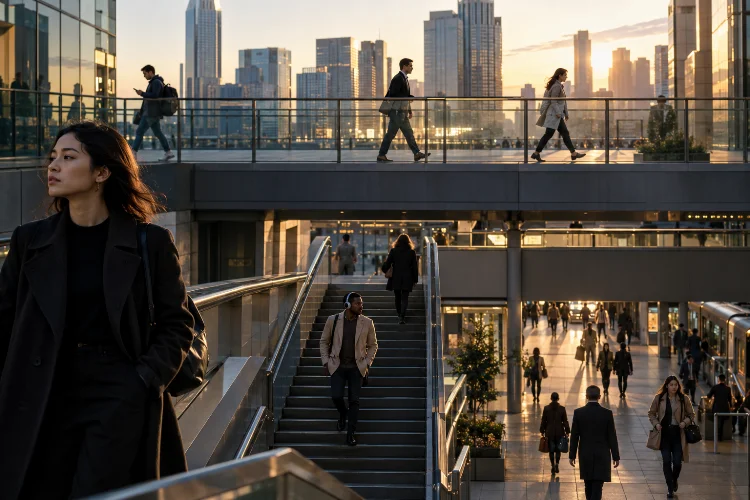
Some films follow one hero from beginning to end. Others ask us to follow several people who may live in different neighborhoods, countries, social classes, or even completely separate worlds. At first, their stories can seem unrelated. Then patterns begin to appear.
This is the power of parallel storylines in contemporary films. By placing several narratives beside one another, filmmakers can create meaning through comparison rather than direct explanation.
One character’s success may highlight another character’s failure. A private tragedy can suddenly feel connected to a much larger social problem.
Films such as Magnolia, Traffic, Babel, and Amores Perros demonstrate how effective this approach can be. Their characters do not always share the same goals or even meet each other, yet their experiences gradually form a larger thematic picture.
Parallel storytelling therefore does more than make a movie structurally complex. When used carefully, it allows cinema to explore relationships between individuals, communities, systems, and emotions that a single-protagonist narrative might struggle to show.
What Are Parallel Storylines in Film?
Parallel storylines involve two or more narrative threads developing within the same film.
Sometimes those stories eventually intersect. In other cases, the characters remain separate while their experiences are connected through theme, location, coincidence, emotion, or a shared social problem.
This structure is sometimes described as a multi-strand, mosaic, hyperlink, or network narrative. The exact terminology varies, but the basic principle remains similar: meaning is created partly through relationships between different narrative threads.
Paul Thomas Anderson’s Magnolia is a classic example. The film follows numerous characters across the San Fernando Valley during roughly the same period.
BFI describes the movie as a three-hour dramatic journey involving many characters who orbit around overlapping situations and relationships.
Instead of asking audiences to invest in only one protagonist, the film distributes attention across an ensemble.
That changes how we watch.
We stop looking exclusively for one character’s destination and begin searching for patterns between several lives.
Parallel Narratives Build Meaning Through Comparison
One of the greatest strengths of parallel storytelling is comparison.
When two stories are placed beside each other, viewers naturally compare them – even if the film never explicitly asks them to.
Imagine one storyline involving a wealthy family worried about losing social status while another follows a struggling family worried about paying rent. Both may experience anxiety, but the reasons and consequences are dramatically different.
The contrast creates meaning.
This is why cross-cutting between separate characters can function almost like an argument. The editing tells audiences, “Look at these experiences together.”
Traffic, directed by Steven Soderbergh, uses multiple narrative threads to explore the American drug war from different positions. Its story moves among political officials, law enforcement, drug trafficking networks, and families affected by addiction.
Rather than reducing the issue to one hero and one villain, the parallel structure shows a larger system.
Analysis of the film often describes it as a procedural mosaic whose meaning accumulates through separate narrative tracks rather than a single protagonist’s journey.
The structure itself becomes part of the message: complicated social problems rarely have only one perspective.
Separate Characters Can Reveal a Shared Emotional Theme
Parallel stories do not need strong plot connections to feel unified.
Sometimes emotion is enough.
In Magnolia, characters experience very different problems involving illness, regret, family conflict, addiction, loneliness, guilt, and failed relationships. Their situations are not identical, but their emotional struggles echo one another.
That repetition creates thematic unity.
A dying father seeking forgiveness can be placed beside an adult child dealing with old resentment. Another character may be desperately searching for affection while someone elsewhere pushes intimacy away.
The stories begin to “rhyme.”
This is one reason Anderson’s editing is so important. The movie frequently moves between characters experiencing emotional crises at similar moments, allowing separate events to amplify each other.
Research and criticism surrounding Magnolia often highlight its intersecting narratives, coincidence, overlapping plots, and multiple protagonists as essential parts of its structure.
The audience gradually understands that the movie is not really about several disconnected problems.
It is about different forms of human pain and the possibility of connection.
Parallel Storylines Can Show Cause and Effect Across Distance
Another powerful use of parallel storytelling is showing how one action affects people who seem completely unrelated.
Babel builds much of its narrative around this idea.
The film moves between Morocco, Japan, Mexico, and the United States, connecting characters across enormous geographical and cultural distances.
These stories initially appear independent, but the film gradually reveals causal and thematic relationships between them.
Academic discussion of Babel identifies it as a prominent network narrative built around multiple locations, cultures, and narrative strands.
A seemingly small action in one location can produce consequences thousands of miles away.
This creates a cinematic representation of globalization.
Characters do not need to know one another for their actions to become connected.
That idea feels particularly relevant in contemporary life, where economic decisions, political events, technology, migration, and media can link people who will never meet.
Parallel narratives make those invisible connections visible.
Instead of explaining global interdependence through dialogue, a film can simply place connected lives beside one another and let audiences discover the relationship.
Editing Turns Separate Stories Into One Larger Argument
Parallel storytelling depends heavily on editing.
Simply having several characters does not automatically create meaningful connections. The order in which scenes appear determines how audiences compare them.
A filmmaker might cut from a wedding to a funeral.
Neither scene changes individually, but their placement creates a relationship between celebration and loss.
Similarly, cutting between two parents protecting their children can highlight similarities between people from completely different cultures.
This technique is especially visible in Babel. Its stories are cross-cut in ways that create the impression of simultaneity and encourage emotional comparisons between characters.
Analysis of the film notes that gestures, sounds, and emotional moments in one location often respond to moments in another.
Editing therefore becomes more than a way to keep multiple stories organized.
It becomes a meaning-making tool.
The cut itself tells us that two moments belong together.
This is one of the most important lessons for screenwriters and filmmakers working with complex narrative structures: the relationship between scenes can communicate ideas that neither scene could express alone.
Multiple Perspectives Make Social Issues More Complex
Films dealing with social or political issues can become overly simple when everything is filtered through one protagonist.
Parallel storylines offer another option.
By showing the same system from different positions, filmmakers can reveal contradictions that would otherwise remain invisible.
Traffic is a strong example because the drug trade appears differently depending on who experiences it. For a politician, drugs may represent a policy problem. For law enforcement, they become an operational challenge. For a family, addiction becomes painfully personal.
No single storyline contains the whole truth.
Together, however, they create a broader picture.
This multi-perspective structure prevents the film from offering an overly clean solution. The problem is larger than any individual character.
That complexity is one reason network narratives became especially useful for films interested in globalization, urban life, migration, inequality, and institutional systems.
A single hero can represent an experience.
Multiple protagonists can represent a network.
That difference may seem subtle, but narratively it is extremly important.
Parallel Stories Can Make Coincidence Feel Meaningful
Coincidence is usually dangerous territory for storytellers.
Too much of it can make a plot feel artificial. Yet films built around parallel narratives can use coincidence as a central theme rather than an accidental shortcut.
Magnolia openly embraces this idea.
Its opening establishes stories of strange coincidences before moving into the interconnected lives of its main characters. This encourages audiences to think about chance, fate, and whether apparently random events might contain some larger pattern.
The film’s characters repeatedly cross emotional and physical paths.
Some connections are direct. Others exist only because the editing places two experiences beside each other.
The effect encourages viewers to search for meaning within chaos.
That is particularly appropriate for an ensemble narrative because viewers are constantly asking why these specific stories have been placed in the same movie.
Florian Zeller has described Magnolia as a film about multiple human destinies and the search for meaning within a chaotic and unstable universe.
Parallel storytelling turns that philosophical question into narrative form.
Maybe everything is connected.
Maybe audiences simply need connections in order to make chaos understandable.
Different Locations Can Expand the Scale of a Film
Parallel storylines also allow filmmakers to dramatically increase narrative scale.
A conventional protagonist-centered film usually follows wherever that character can physically go.
A network narrative has fewer restrictions.
One storyline can take place in Tokyo while another unfolds in Morocco. A third can cross the Mexico-US border while another stays inside an American household.
Babel uses this geographical freedom extensively. Scholarship on the film notes its multilingual dialogue, multicultural characters, multiple locations, and thousands of individual edits and setups.
The result feels larger than any individual storyline.
Yet scale alone is not enough.
Successful parallel narratives usually create some thematic bridge between locations. Otherwise, the movie can feel like several short films randomly placed together.
The locations must contribute to a shared idea.
In Babel, geographical distance repeatedly contrasts with emotional similarity. Characters may speak different languages and inhabit radically different environments, yet they experience grief, isolation, fear, misunderstanding, and the desire for connection.
Physical distance becomes a way of revealing emotional closeness.
Parallel Narratives Increase Audience Participation
Multi-strand films demand more attention from viewers.
Audiences must remember characters, relationships, locations, and unfinished conflicts while switching between narrative threads.
This can make the viewing experience more active.
Instead of receiving every connection immediately, viewers construct a mental map.
Who is related to whom? Are these events happening simultaneously? Will these characters eventually meet? Why did the film cut from this story to that one?
These questions create curiosity.
In films like Babel, chronology itself may also be manipulated. The different threads can appear simultaneous even when they are not perfectly aligned in time.
That makes the audience responsible for reconstructing part of the narrative.
However, filmmakers need to balance complexity with clarity.
Too many underdeveloped storylines can make audiences feel disconnected. Each narrative thread needs enough personality, conflict, and emotional purpose to remain memorable.
Complexity should create discovery, not just confusion.
When the structure is succesful, viewers experience the pleasure of recognizing connections for themselves.
Why Parallel Storylines Often Create Deeper Meaning
A single storyline can tell us what happened to one person.
Parallel storylines can ask what several experiences mean when viewed together.
That difference gives filmmakers enormous thematic freedom.
Two characters can represent opposing responses to the same problem. Separate families can reveal different forms of love. People living thousands of miles apart can unknowingly participate in the same chain of consequences.
Meaning then emerges between stories rather than only inside them.
This is why multi-strand cinema often feels broader than conventional character drama. Films can explore systems, societies, communities, and shared human experiences without abandoning individual emotion.
The best examples also avoid explaining every connection.
They trust audiences to recognise visual, thematic, or emotional patterns.
That trust is important.
When viewers discover those relationships themselves, the movie becomes something they actively interpret rather than simply consume.
Parallel storylines create deeper meaning in contemporary films by allowing different characters, emotions, locations, and social realities to speak to one another.
Movies such as Magnolia, Traffic, and Babel show how separate lives can form a larger narrative pattern through editing, contrast, coincidence, and thematic connection.
The technique is especially powerful when filmmakers want to explore complicated systems or universal emotions that cannot be represented by a single protagonist.
For viewers, multi-strand narratives also make cinema more participatory. We have to notice patterns and understand why apparently unrelated scenes belong together.
Next time you watch a film with several overlapping stories, pay attention to the transitions. Ask why one scene follows another. Quite often, the deepest meaning is found not inside either storyline, but somewhere in the space between them.
